


Minority-Owned Contractor Loans NYC: Best Funding Options for 2026
Running a minority-owned construction company in New York City means juggling tight timelines, large material costs, and payroll — often before a single invoice gets paid. Minority-owned contractor loans in NYC have expanded significantly in recent years, yet many business owners still don’t know which options are fastest, most affordable, or easiest to qualify for. In this guide, we break down every viable funding path available to MBE and DBE contractors in 2026.
Why Minority Contractors Face a Funding Gap
Access to capital remains one of the biggest obstacles for minority-owned construction companies across the country. According to Federal Reserve research, minority-owned firms are significantly less likely to receive full financing approval compared to their white-owned counterparts, even when they present similar financials.
In construction, the problem is even more pronounced. Material costs are high, payment cycles are long, and banks often view the industry as high-risk. Furthermore, many minority contractors are newer businesses or operate as sole proprietors, making it harder to meet traditional lending criteria like two or more years in business and strong personal credit.
However, the landscape is changing fast. New York City and New York State have both launched targeted programs specifically designed to bridge this gap. In addition, alternative lenders now offer products that banks simply don’t — faster approvals, flexible terms, and criteria based on cash flow rather than credit score alone.
Best Loan Options for Minority Contractors in NYC
1. Merchant Cash Advance (MCA)
A merchant cash advance is one of the fastest ways to get capital as a contractor. Instead of a fixed monthly payment, you repay a percentage of your daily or weekly revenue. This makes it ideal for contractors with variable income between projects.
Approvals typically happen within 24–48 hours, and funding can arrive the next business day. Moreover, credit requirements are flexible — many lenders approve applicants with scores as low as 500. The trade-off is cost: factor rates on MCAs typically range from 1.15 to 1.45, so they work best for short-term bridge needs.
2. Equipment Financing
Construction businesses are equipment-intensive. Fortunately, equipment financing is one of the most accessible loan types because the equipment itself serves as collateral. As a result, lenders are less concerned about your credit score and more focused on the value and useful life of the asset.
Terms typically range from 24 to 84 months. Interest rates are often lower than unsecured loans, and the payments are predictable — making cash flow planning much easier.
3. Invoice Factoring
If you’re waiting 30, 60, or even 90 days for general contractors or city agencies to pay your invoices, invoice factoring can solve your cash flow problem immediately. With factoring, you sell your outstanding invoices to a lender for 80–90% of their face value upfront — and receive the remainder (minus a fee) once the invoice is paid.
For minority contractors who do work with NYC agencies or large GCs, this is one of the most powerful tools available. In particular, it lets you take on new jobs without waiting for old ones to pay out.
4. Business Lines of Credit
A revolving business line of credit gives you access to a pool of capital you can draw from as needed — and only pay interest on what you use. For contractors managing multiple projects simultaneously, this flexibility is invaluable.
Lines of credit from alternative lenders are available from $10,000 to $500,000, with approval times ranging from one to five business days.
5. Small Business Loans (Term Loans)
Traditional small business loans provide a lump sum repaid over a fixed term — typically 6 months to 5 years. These are well-suited for larger, planned investments like hiring crews, opening an office, or covering a significant project mobilization cost.
Many alternative lenders offer these with more lenient requirements than banks, and some specialize in construction-industry borrowers specifically.
Funding Options Compared at a Glance
| Funding Type | Typical Amount | Speed | Min. Credit Score | Best For |
|---|---|---|---|---|
| Merchant Cash Advance | $5K – $500K | 24–48 hrs | ~500 | Short-term bridge capital |
| Equipment Financing | $10K – $5M | 2–5 days | ~580 | Purchasing/leasing equipment |
| Invoice Factoring | Up to 90% of invoice | 1–3 days | No minimum | Improving cash flow on net terms |
| Business Line of Credit | $10K – $500K | 1–5 days | ~600 | Ongoing flexible capital |
| Term Loan | $25K – $2M | 3–10 days | ~620 | Larger planned expenditures |
| SBA 7(a) Loan | Up to $5M | 30–90 days | ~650 | Long-term growth investment |
Government & Grant Programs in NYC and New York State
Beyond private lenders, New York City and New York State offer several programs specifically targeted at minority, women-owned, and disadvantaged business contractors. These programs won’t replace fast alternative lending, but they can significantly reduce your cost of capital over time.
NYC Minority Business Enterprise Guaranty Facility ($50M)
New York City launched a $50 million MBE Guaranty Facility — with an additional $25 million match from Goldman Sachs — specifically to reduce capital barriers for minority-owned developers working on construction and affordable housing projects. This program acts as a loan guarantee, helping MBE contractors access commercial credit that might otherwise be out of reach.
New York State Contractor Financing Program ($37M)
Empire State Development’s Contractor Financing Program uses $37 million in SSBCI funding to directly support minority, women-owned, and disadvantaged contractors across New York. The program offers below-market financing specifically designed to help smaller contractors take on larger public contracts without being choked by cash flow gaps.
NYC Future Fund (2026)
Launched in early 2026, the NYC Future Fund is an $80 million affordable lending program with loans starting at just $25,000 and interest rates as low as 7.5%. The revenue requirement has also been reduced to $50,000 annually, making it far more accessible for newer or smaller construction firms. Furthermore, the Fund specifically targets minority-owned and immigrant-owned businesses across all five boroughs.
SBA 8(a) Business Development Program
For longer-term growth, the SBA 8(a) program gives minority-owned businesses access to federal contracting set-asides as well as mentorship and SBA loan programs. The qualification process takes time, but certified 8(a) contractors gain a significant competitive advantage in bidding on government construction projects.

How to Qualify – Even Without Perfect Credit
One of the most common misconceptions minority contractors have is that they need excellent credit to qualify for business funding. In reality, alternative lenders evaluate your application very differently from a traditional bank.
What Alternative Lenders Actually Look At
Most alternative lenders focus primarily on your monthly revenue and cash flow consistency. They also consider how long you have been in business – typically six months to one year is enough. Additionally, they review your bank statements to confirm regular deposits and assess whether you have any open bankruptcies or judgments.
Credit score thresholds are much lower than banks. Indeed, many lenders approve borrowers with scores between 500 and 580. For bad credit business loans, even scores below 500 may qualify depending on revenue strength.
Documents You’ll Typically Need
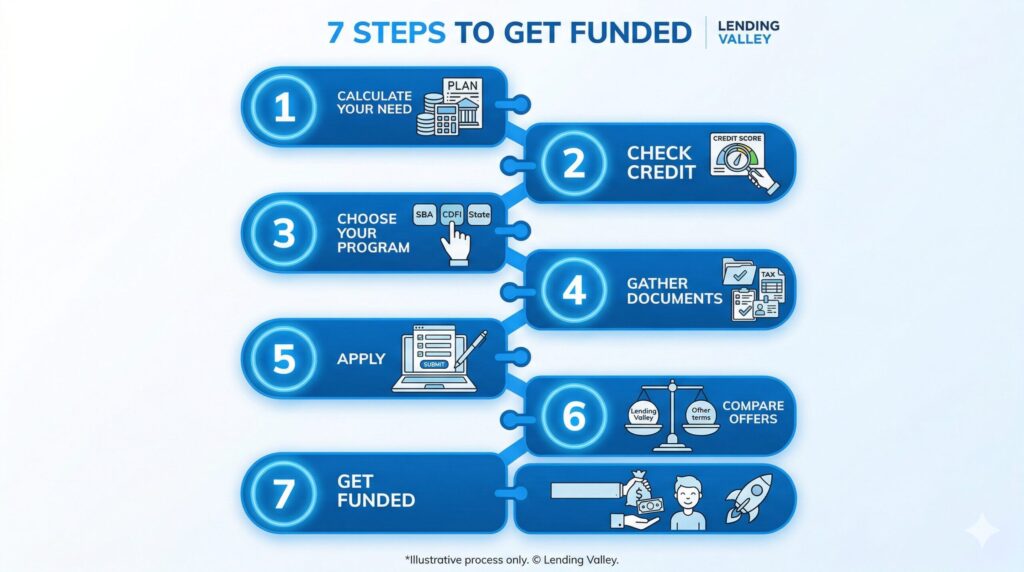
Gather these documents before applying to speed up the process considerably:
- 3–6 months of business bank statements
- Government-issued photo ID
- Proof of New York business registration
- MBE, WBE, or DBE certification (if applicable — helps with government programs)
- Most recent business tax return
- Voided business check
Tips to Strengthen Your Application
First, ensure your bank deposits are consistent and clearly labeled. Second, separate your personal and business finances — mixed accounts are a red flag for lenders. Third, if you carry MBE or DBE certification, include it in every application — it opens doors to specific government-backed programs. Finally, apply with a lender experienced in the construction industry, since they understand payment cycles and seasonal revenue patterns far better than generalist banks.
“We work with contractors across all five boroughs who’ve been turned down by banks. Our job is to look past the credit score and find the business behind the numbers.” — Lending Valley
Ready to Get Funded?
Apply in minutes. Get a decision in 24 hours. Funding for minority-owned contractors across New York City.
Frequently Asked Questions
What types of loans are available for minority-owned construction companies in NYC?
Minority-owned construction companies in NYC can access merchant cash advances, equipment financing, invoice factoring, SBA 7(a) loans, business lines of credit, and alternative lender products. Moreover, programs like the NYC Future Fund and New York’s Contractor Financing Program also offer targeted support for MBE and WBE contractors.
How quickly can a minority contractor in NYC get business funding?
Through alternative lenders like Lending Valley, approved minority contractors can receive funding in as little as 24–72 hours. Traditional bank loans and government programs, however, typically take 30–90 days to process — making them better suited for planned investments rather than urgent needs.
Do I need perfect credit to get a contractor loan as a minority business owner in NYC?
No — and this is important. Many alternative lenders approve minority contractors with credit scores as low as 500–550. Lenders like Lending Valley evaluate your monthly revenue, time in business, and cash flow — not just your credit score alone.
Are there grants specifically for minority-owned construction companies in NYC?
Yes. NYC’s $50 million MBE Guaranty Facility, New York State’s $37 million Contractor Financing Program, and the newly launched NYC Future Fund all target minority and disadvantaged contractors. These programs offer loan guarantees, subsidized loans, and below-market interest rates specifically for qualifying businesses.
What documents do minority contractors typically need to apply for a business loan in NYC?
Most alternative lenders require 3–6 months of business bank statements, a valid government-issued ID, proof of business registration in New York, and your MBE or DBE certification if applicable. Some lenders also request your most recent tax returns and a voided business check.
The Bottom Line
Minority-owned contractor loans in NYC are more accessible than ever — but only if you know where to look. Alternative lenders can fund your construction business in 24–72 hours, with flexible credit requirements and loan structures built for the realities of contracting work. Furthermore, New York City and New York State are actively investing hundreds of millions of dollars to help MBE and DBE contractors compete at every level.
Don’t let a funding gap hold your business back. Whether you need bridge capital for materials, financing for new equipment, or working capital to bridge the gap between projects, Lending Valley works with minority contractors across all five boroughs to find the right solution — fast.
Sources: Federal Reserve Small Business Credit Survey | Empire State Development Contractor Financing Program | SBA 8(a) Business Development Program