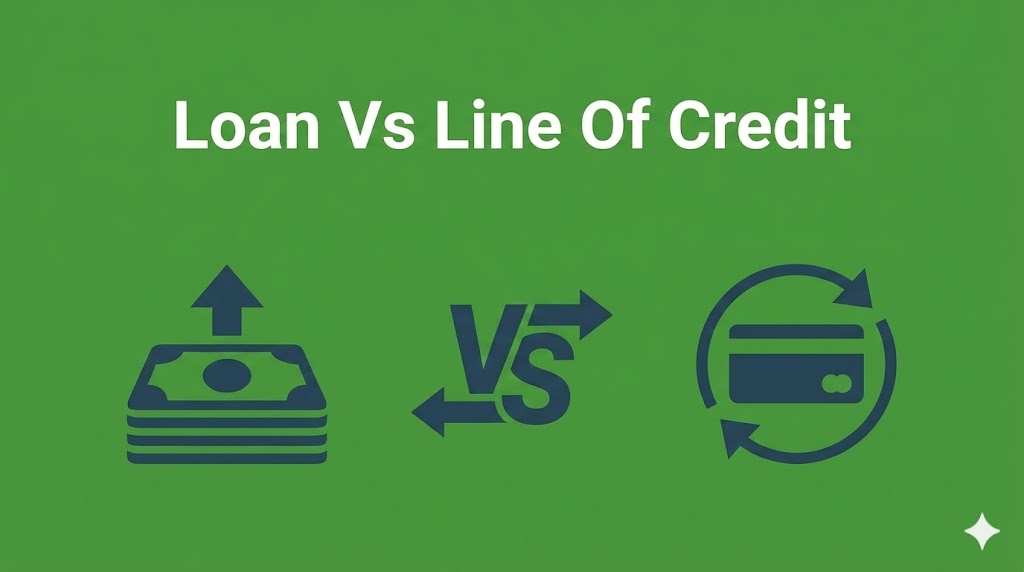
It’s 2 AM. You are staring at your business bank account, and the math isn’t mathing. You need capital. That part is clear.
But when you start Googling, you are hit with a wall of terminology: Term Loans. Revolving Credit. Amortization. Draw Periods. It’s enough to make you close the laptop and hope the problem disappears (spoiler: it won’t).
In 2025, access to capital is faster than ever, but it’s also more complex. Choosing the wrong funding structure can trap your business in a cycle of debt that stifles growth. Choose the right one, and it’s like pouring rocket fuel on a fire.
So, let’s settle the debate: Loan vs. Line of Credit. Which one does your business actually need?
I’m going to break this down without the banking jargon, using real examples from Brooklyn to Texas, so you can make a decision with confidence.
Deciding between a loan and a credit line is just the first step; to learn how to deploy this capital specifically for online retail growth, read our strategy for Scaling Shopify Stores Without Equity.
The Simple Analogy: The Mountain vs. The Stream
Before we look at interest rates, let’s look at function.
1. The Term Loan (The Mountain)
Think of a Business Term Loan as a mountain. You get a massive lump sum of dirt (cash) all at once to build something big.
The Structure: You get $100,000 today. You pay it back over 5 years with interest.
The Vibe: Predictable, stable, heavy.
Best For: Buying a building, purchasing heavy machinery, or a major renovation.
2. The Line of Credit (The Stream)
Think of a Business Line of Credit (LOC) as a stream running through your backyard. You can dip your bucket in to get water (cash) whenever you need it. If you don’t need water, you don’t touch it, and you don’t pay for it.
The Structure: You are approved for up to $100,000. You take $10k for payroll this week. You only pay interest on that $10k. You pay it back, and your limit goes back up to $100k.
The Vibe: Flexible, fast, reactive.
Best For: Inventory gaps, payroll, seasonal slumps, or emergency repairs.
While term loans are great for one-time purchases, a Line of Credit For Inventoryis the superior choice for recurring costs learn why in our detailed guide.
Expert Insight for 2025:
“The biggest mistake I see business owners make is using a Line of Credit for long-term investments. If you use a variable-rate LOC to buy a truck, and rates spike in 2025, your payment skyrockets. Use fixed loans for assets; use lines of credit for cash flow.” — James L., Senior Underwriter, Fintech Sector.
To understand which is better, let’s look at how businesses across the US are actually using them right now.
Case Study 1: The Big Expansion (The Term Loan)
Location: Houston, Texas
Business: Lone Star Logistics
The Situation: The owner, Marcus, won a massive contract to haul pipes for an oil field. He needed three new semi-trucks immediately. The cost was $450,000.
The Choice: He looked at Business funding in Texas. A Line of Credit would be risky because the interest rates are usually variable (floating). He needed to know exactly what his monthly bill would be for the next 5 years to price his contract correctly.
The Solution: He took a Term Loan.
The Result: He got a fixed APR of 9%. The predictable payments allowed him to manage his cash flow perfectly. The trucks (assets) served as collateral.
Case Study 2: The Inventory Gap (The Line of Credit)
Location: Brooklyn, New York
Business: Greenpoint Coffee Roasters
The Situation: It’s October. Holiday orders are flooding in, but the clients won’t pay until January. The owner, Sarah, needs to buy $40,000 worth of raw beans now to fulfill the orders. She doesn’t have the cash on hand.
The Choice: If she takes a term loan, she has to pay interest on the whole amount for years. She only needs the money for 90 days.
The Solution: She utilized a Business Loan in Brooklyn structured as a Line of Credit. She drew $40,000, bought the beans, fulfilled the orders, and paid off the balance in January when the checks cleared.
The Cost: She only paid interest for 3 months.
Case Study 3: The “Bridge” Strategy (Small Business Funding in Ohio)
Location: Columbus, Ohio
Business: Midwest Retail Boutique
The Situation: The HVAC system died in the middle of a heatwave. It was an emergency $15,000 repair.
The Choice: The owner applied for Small Business funding in Ohio through a traditional bank, but they said it would take 4 weeks. She couldn’t wait.
The Solution: She used a specialized revolving line of credit (similar to an MCA hybrid). It was faster to approve.
The Result: The shop stayed open. While the rate was higher, the speed saved her thousands in lost revenue.
It takes 2 minutes and won’t impact your credit score.
Fact: While similar, a LOC usually offers cash access (transferable to your checking account) much cheaper than a credit card cash advance. Plus, LOC limits are typically much higher ($50k–$500k) than a standard credit card.
Myth: “I can’t get funding because I have bad credit.”
Fact: This used to be true. Now, if you are looking for Business funding in Newyork or Business funding in Texas, lenders look at revenue more than FICO scores. If your cash flow is strong, you can get approved.
Myth: “Applying hurts my credit score forever.”
Fact: Most modern lenders do a “soft pull” to show you offers. It only affects your score if you accept the offer and sign the hard inquiry.
Using Short-Term Cash for Long-Term Assets:Don’t buy a $100,000 machine with a Line of Credit. You’ll tie up your working capital. Use a term loan for the machine; save the LOC for payroll.
Applying to the Wrong Lender:If you need Business loan in Florida for a tourism business, don’t apply to a bank in Nebraska. Local or specialized knowledge matters.
Ignoring the “Draw Period”:Many LOCs have a draw period (e.g., 12 months) followed by a repayment period. If you don’t know when your draw period ends, you might get cut off unexpectedly.
How Lending Valley Solves The Problem
Searching for “Merchant Cash Advance near me” or “Best Business Loans” will give you 10 million results. It’s overwhelming.
Lending Valley is not just another lender. We are your funding architect.
Here is how we do it differently:
We Compare For You: We have a network of banks, credit unions, and private lenders. We pitch your profile to them and make them compete.
Hybrid Solutions: Sometimes, the answer isn’t “Loan vs. LOC.” It’s both. We often structure deals where a client gets a term loan for a big purchase AND a smaller LOC for a safety net.
Speed & Human Touch: Whether you need Small Business funding in Ohio or an MCA in Newyork, you get a dedicated advisor. We explain the fine print—no hiding fees.
A: generally, yes. Because a LOC is “unsecured” (no collateral), lenders require a slightly higher credit score (usually 660+) and stronger revenue history compared to a secured term loan.
Q: Can I have both a Term Loan and a Line of Credit?
A: Absolutely. This is actually the “Gold Standard” of capital structure. Use the loan for growth and the LOC for insurance.
Q: I’m searching for an “MCA in Newyork.” Is that a Line of Credit?
A: No. An MCA (Merchant Cash Advance) is a purchase of future sales. It is not a loan or a line of credit. It is faster but usually more expensive. If you can qualify for a LOC, it is almost always cheaper than an MCA.
Q: Does Lending Valley help with “Business loan in Florida” specifically?
A: Yes. We operate nationwide. Whether you are in Miami, FL, or Columbus, OH, we understand the local industries and pair you with lenders who “get” your market.
Q: What is a “Revolving” Line of Credit?
A: Revolving means the credit refreshes. If you have a $20k limit and spend $5k, you have $15k left. If you pay that $5k back, your limit goes back up to $20k. It cycles.
Q: How fast can I get funded?
A: With traditional banks? Weeks. With Lending Valley, we can often get you approved for a Line of Credit or Term Loan in as little as 24 hours.
Q: Do I need collateral for a Line of Credit?
A: Usually, no. Most small business LOCs are unsecured. However, for very large lines ($250k+), lenders may ask for a UCC lien on your business assets.
The Verdict: Which One Wins?
Here is the bottom line for 2025:
Choose a Term Loan if: You are making a big purchase that will make you money over the next 5-10 years (Equipment, Real Estate, Renovation).
Choose a Line of Credit if: You need a safety net for payroll, inventory, or seasonal dips. You want peace of mind.
Don’t guess with your business’s future. The market is volatile, and interest rates are tricky.
CEO at Lending Valley, a pioneer in the Fintech and alternative lending space. He has assisted thousands of business owners to receive funding over the last 10 years and is focused on helping one small business at a time achieve access to capital.