

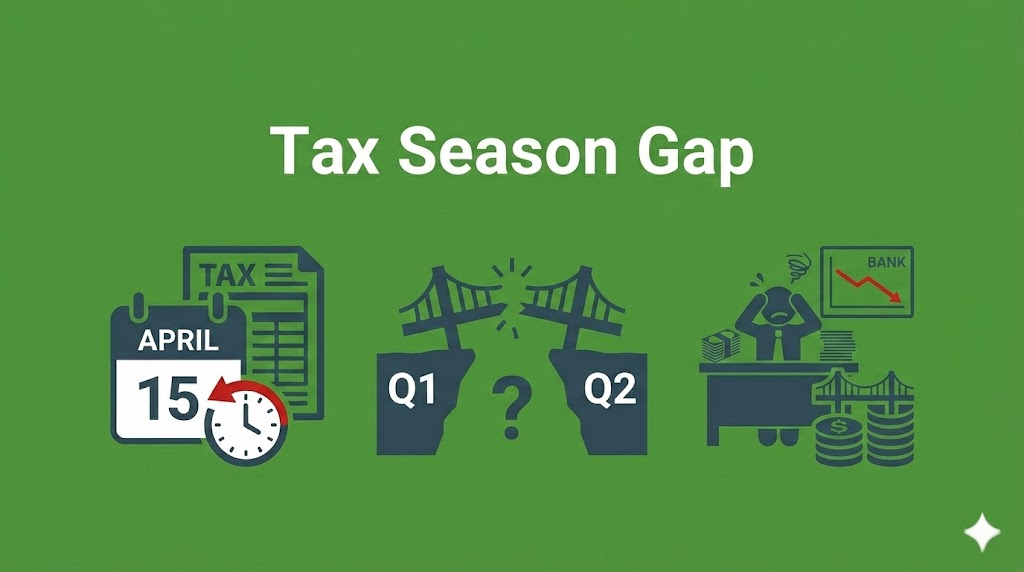
It is the dirty little secret of the accounting world, and if you run a firm, you know exactly what it feels like.
On paper, your firm is killing it. You and your team just logged 60-hour weeks through February and March. Your billable hours are at an all-time high. Your Work-In-Progress (WIP) report looks fantastic perhaps the best it has been in years.
But then you look at the bank account in mid-April, and the reality hits hard.
The balance is terrifyingly low. Why? Because you have done the work, but you haven’t been paid yet. You are stuck in the Tax Season Gap. Your staff needs to be paid now likely with overtime bonuses to prevent burnout but your clients won’t send their checks until May or June. This cash flow valley kills more profitable firms than a lack of clients ever could.
In this deep dive, we are going to break down exactly how to bridge this gap in 2026 using smart accounting firm working capital strategies, real-world case studies, and actionable steps to keep your payroll funded without panicking.Beyond just billing faster, consider Investing in FinTech to automate your entire invoicing workflow; automated reminders typically get paid 30% faster than manual emails.
Whether you are a veteran CPA firm waiting on invoices or a startup entrepreneur seeking funding with a new LLC, the golden rule remains the same: you cannot pay your employees with ‘pending’ revenue.
The Anatomy of the “Tax Season Gap”
Let’s define the problem so we can fix it. The Tax Season Gap is a specific liquidity crisis that hits professional service firms in Q2. It isn’t a profitability issue; it’s a timing issue. It is caused by the misalignment of three critical cycles:
Fundamentally, this is not a profitability issue; it is a timing issue. Your P&L might show record profits on an accrual basis, but your bank account tells a different story. This friction is caused by the dangerous misalignment of three critical cycles that every firm owner must navigate.
The Production Cycle (The Cash Outflow) First, you have the Production Cycle. This is where the actual work happens, primarily in Q1 (January through March). During this period, your firm incurs massive, immediate costs that cannot be deferred. You are paying regular salaries, but you are likely also paying significant overtime or seasonal staff wages to handle the volume. You are fronting the cost for expensive tax software licenses, research tools, and increased overhead. Essentially, cash is flying out the door to keep the factory running at 110% capacity, but no new cash is coming in yet to replace it.
The Billing Cycle (The Paperwork Lag) Next comes the Billing Cycle. In a perfect world, you would bill as you work (progress billing). But in the tax world, billing often lags significantly behind production. You typically cannot send the final invoice until the return is completed, reviewed, signed, and filed which usually happens in late Q1 or early Q2. This creates a natural, unavoidable delay. You have already paid your staff for the hours they worked in February, but you might not even generate the invoice for that work until the April 15th deadline approaches.
The Collection Cycle (The Waiting Game) Finally, there is the Collection Cycle, which is often the most painful part of the equation. Even after you send that invoice in April, the money doesn’t magically appear. You are at the mercy of your client’s payment habits. Corporate clients often prioritize their own cash flow, treating your “Net 30” invoice as a “Net 60” suggestion. Furthermore, many individual clients may wait until they receive their federal tax refunds before paying your fee. This pushes the actual receipt of cash deep into mid-to-late Q2 (May or June), leaving you with a massive gap between when you paid your expenses (January) and when you finally get your money (June).
Just as other industries are being crushed by a Parts Inflation Squeeze, accounting firms are seeing the cost of their essential ‘parts’ qualified CPAs and secure server space hit all-time highs.
Why the Gap is Wider in 2026
According to updated 2025/2026 industry data, the Tax Season Gap is widening for three specific reasons:
- The Cost of Talent: The “Talent Wars” have pushed CPA salaries up by roughly 12-15% over the last two years. You are paying more for the same output, and those payroll runs are non-negotiable.
- Tech-Flation: Firms are increasingly adopting AI and automation tools. Unlike old software bought once, these are heavy monthly subscriptions or large upfront implementation costs that hit your P&L before the revenue arrives.
- Slower Client Payments: As interest rates hover, clients are holding onto their cash longer. The average Days Sales Outstanding (DSO) for tax firms has crept up from 45 days to nearly 60 days.
You need a bridge. You need tax season bridge loans or a specialized line of credit that understands this cycle.
Talk to a CPA Funding Specialist, Let’s build a strategy to bridge the gap and keep your
3 Real-World Case Studies: How Firms Are Surviving
To show you how this works in practice, let’s look at three firms that faced the Tax Season Gap and solved it using strategic financing.
Case Study 1: The Brooklyn Payroll Panic (New York)
The Situation: A 12-person firm in Brooklyn had a massive tax season. However, their rent and crucial staff retention bonuses were due on April 15th. Their receivables totaled $400k, but their liquid cash on hand was barely $20k. The Challenge: They tried to get Business funding in Newyork through a traditional bank, but the approval timeline was 6 weeks. They didn’t have 6 weeks; they had days. The Solution: They utilized a revolving line of credit specifically designed for professional service firm financing. The Result: They drew down $150k to cover payroll and bonuses immediately. By June 1st, as client checks rolled in, they paid the line back in full. The cost of capital was negligible compared to the risk of losing key staff. For firms seeking a Business Loan in Brooklyn, speed is often more valuable than the interest rate.
Case Study 2: The Acquisition Opportunity (Florida)
The Situation: A firm in Miami found a perfect competitor to acquire. The seller, burned out, wanted out immediately after tax season. The buyer needed CPA practice acquisition loans quickly to lock in the deal before summer, but their cash was tied up in AR. The Challenge: The firm had equity but no liquidity. They risked losing the deal to a larger aggregator. The Solution: They secured a Business loan in Florida structured as a bridge loan. This allowed them to make the down payment on the acquisition using their projected May collections as collateral. The Result: They acquired the firm, adding $600k in annual revenue. This is a classic example of using leverage to grow rather than just survive the Tax Season Gap.
Case Study 3: The Partner Buyout (Texas)
The Situation: A senior partner at a Dallas firm decided to retire early. The operating agreement required a lump sum payout by May 1st, right when the firm’s cash was lowest. The Challenge: The firm needed accounting firm working capital to fund these buy out partner loans without draining the operating account needed for summer overhead. The Solution: They sought Business funding in Texas via a term loan. Unlike a line of credit, this gave them a lump sum with a 3-year payback period, smoothing the cash flow hit over time.
Strategic Solutions: Not All Cash Is Created Equal
When you are in the hole, it is tempting to grab the first lifeline you see. But if you search for “Merchant Cash Advance near me” out of desperation, you might make a fatal mistake.
Here is a comparison of your options for bridging the Tax Season Gap:
| Funding Type | Speed | Cost | Best Use Case |
| Traditional Bank Line | Slow (4-8 weeks) | Low | Setting up before the season starts. |
| Fintech Bridge Loan | Fast (24-72 hours) | Moderate | Covering April payroll or sudden tax season bridge loans. |
| Merchant Cash Advance (MCA) | Instant | High | Emergency only. Avoid if possible. |
| SBA 7(a) | Very Slow (3+ months) | Low | Buying real estate or major acquisitions. |
Export to Sheets
A Warning on MCAs
If you are looking for MCA in Newyork or other high-cost hubs, be careful. These are not loans; they are sales of future revenue. They often take daily payments from your bank account.
- Expert Insight: “I’ve seen perfectly healthy CPA firms almost go under because they took a high-interest MCA to cover a $50k payroll gap. The daily draws strangled their cash flow in July when revenue dipped.” — Mike T., Senior Funding Advisor.
5 Actionable Tips to Shorten the Gap
Funding bridges the Tax Season Gap, but operational changes can shrink it permanently.
- Bill on Completion, Not Filing: Don’t wait until the return is filed to send the invoice. Bill when the draft is complete and ready for review.
- Retainers are King: Move as many clients as possible to monthly subscription retainers. This smooths cash flow and reduces the desperate need for Small Business funding in Ohio or wherever you are located during the crunch.
- Accept Credit Cards: Yes, the fees sting (approx. 3%). But getting paid in 2 days vs. 45 days is worth the 3% cost to your margin.
- Offer Early Pay Discounts: Offer 2% off if the invoice is paid within 10 days. It encourages clients to prioritize your bill.
- Secure Credit BEFORE You Need It: Apply for professional service firm financing in November, not April. Banks lend to those who don’t look desperate.
Don’t just survive the season build a firm that thrives year-round. Check out our advanced Capital Strategies for CPA Acquisitions to turn your seasonal revenue into long-term equity
Pros vs. Cons: Using Debt to Bridge the Gap
Pros:
- Retention: You can pay staff bonuses on time, keeping morale high in a competitive talent market.
- Growth: You don’t have to pause marketing or hiring during the cash crunch.
- Sleep: You stop staring at the ceiling at 3 AM worrying about the bank balance.
Cons:
- Cost: Interest is a real expense that eats into margins.
- Risk: If a major client leaves or doesn’t pay, you still owe the loan service.
Myths vs. Facts
- Myth: Taking a loan means your firm is failing.
- Fact: The largest firms in the world use accounting firm working capital lines. It’s a tool for liquidity management, not a sign of weakness.
- Myth: You need real estate collateral.
- Fact: Modern lenders lend against your Invoices and WIP. They know your revenue is reliable.
How Lending Valley Solves This
At Lending Valley, we don’t treat CPA firms like restaurants or retail stores. We know that your Tax Season Gap is temporary and that your receivables are solid gold they just haven’t arrived yet.
Why Accountants Choose Us:
- We Understand the Cycle: We know you are cash-poor in April and cash-rich in June. We structure repayment to match that reality.
- Speed: Whether you need Business funding in Texas for a partner buyout or Business Loan in Brooklyn for payroll, we can often fund in 24 to 48 hours.
- No Hard Collateral Needed: We focus on your revenue history and WIP, not your building.
We provide the tax season bridge loans that keep your firm moving so you can focus on the clients, not the bank balance.
FAQs: Managing the Gap
A: A bridge loan is a lump sum usually for a specific purpose (like an acquisition), while a line of credit is revolving you draw what you need, pay it back, and use it again.
A: Absolutely. Many firms use accounting firm working capital to pay for expensive software licenses upfront to get discounts, rather than paying monthly premiums.
A: It can be competitive. Traditional banks in NY are strict. However, alternative lenders look favorably on CPA firms because the default rate is historically low
A: With Lending Valley, if your paperwork is ready, you can have funds the same day or next day.
A: Business revenue matters more than personal credit score for many of our loan products. If your firm is strong, we can usually find a solution.
A: Only as a last resort. Speak to a specialized advisor first. There are often term loan options that are cheaper and safer than an MCA.
A: Yes. Partner buyouts are a common use case. We can structure a loan that allows the exiting partner to get paid while the remaining partners pay it off over time.
Don’t Let the Calendar Kill Your Cash Flow
You’ve done the hard work. You’ve earned the revenue. Don’t let a 45-day delay in collections cause a crisis in your firm. The Tax Season Gap is predictable, manageable, and solvable.
Whether you are looking to acquire a competitor, pay out a retiring partner, or simply ensure your staff gets their well-deserved bonuses on time, liquidity is key. You don’t have to choose between growth and stability you just need the right bridge.
Check Your Funding Eligibility Now,See how much working capital you can access in minutes. No hard credit pull.