Close
It is 2026. The economy has found a new rhythm, but for the average business owner, the hustle hasn’t slowed down for a second. In fact, the window of opportunity has only gotten smaller. When your walk-in freezer dies in the middle of a July heatwave, or a supplier offers you a massive discount on bulk inventory if you can pay cash within 24 hours, you do not have the luxury of waiting 60 days for a traditional bank committee to review your tax returns from two years ago. In these moments, cash flow isn’t just a metric; it is the lifeblood of your survival.
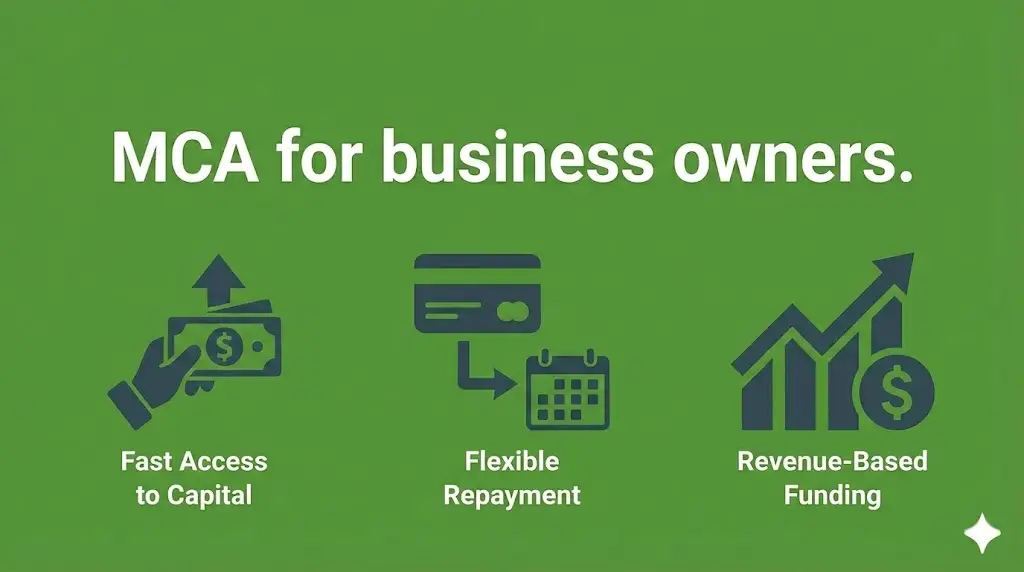
This urgent need for speed is exactly why the MCA for business owners (Merchant Cash Advance) has exploded in popularity over the last few years. It is fast, it is accessible, and it is incredibly flexible. But let’s be real it is also one of the most misunderstood and potentially expensive products on the market. If you are currently scrolling through search results for “Business funding in Newyork” or frantically looking for a “Business Loan in Brooklyn” at 2:00 AM, this guide is written specifically for you. We have gathered the top 10 burning questions business owners ask, backed by 2026 data, real-world case studies, and no-nonsense expert answers to help you decide if this tool is a lifeline or a trap.
The most common misconception is that an MCA is just a loan with a different name. It isn’t. When you utilize an MCA for business owners, you are not borrowing money in the traditional sense. Instead, you are engaging in a sales transaction. You are technically selling a portion of your future revenue (your credit card swipes or bank deposits) to a funder in exchange for a lump sum of cash today.
This distinction matters because since it is a commercial purchase of future receivables rather than a loan, it is not bound by the same usury laws (interest rate caps) that regulate bank loans. This structure allows funders to take on higher risks like funding a restaurant with a 500 credit score but it also means the cost of capital is higher. You aren’t paying interest; you are selling your future income at a discount.If you want to know more about MCA , read out guide for Merchant Cash Advance (MCA).
If speed is your priority, the MCA is the undisputed king of the financing world. Thanks to the massive adoption of AI-driven underwriting in 2026, the timeline has compressed significantly. If you are a busy deli owner looking for a Business Loan in Brooklyn, you can upload your digital bank statements by 10:00 AM, have an algorithm score your cash flow by noon, and see the wire hit your account by 3:00 PM the same day.
According to recent fintech lending reports, the average approval time for algorithmic-based funding has dropped to just 3.5 hours for complete applications. This is why businesses facing emergencie like a plumbing disaster or a sudden payroll gap turn to this option. It bridges the gap between a problem and a solution instantly.
While approval standards vary across the board, certain industries have a significant advantage; for example, MCA approval for doctors is often much faster because lenders view medical insurance reimbursements as highly secure revenue.
This is where the MCA for business owners truly shines compared to traditional banking. Banks are obsessed with your FICO score and your past credit history. MCA providers, however, are obsessed with your now. They care about your “Average Daily Balance” and your monthly gross deposits.
If you have a 550 credit score but your business is depositing $40,000 a month consistently, you are viewed as a prime candidate. We see this often with high-cash-flow businesses seeking Small Business funding in Ohio or industrial hubs. The funder is betting on your business’s ability to generate sales next month, not on whether you missed a personal credit card payment three years ago.If you find yourself overwhelmed by daily withdrawals that don’t match your current revenue, it might be time to bring in a professional. An experienced MCA management companies can often step in to renegotiate terms or restructure the debt, giving your business the breathing room it needs to survive.
Here is where the math gets tricky, and where you need to pay the most attention. MCAs do not use an Annual Percentage Rate (APR). Instead, they use a “Factor Rate,” which typically ranges from 1.10 to 1.50. It sounds small, but it adds up fast.
For example, if you request $20,000 with a factor rate of 1.30, your total payback amount is $26,000 ($20,000 x 1.30). The “cost” of the capital is $6,000. While that seems straightforward, the speed of repayment determines the effective APR. If the lender takes that $26,000 back over just four months, the annualized interest rate is triple digits. It is expensive capital, designed for short-term bursts, not long-term holding.
Unlike a monthly mortgage payment, an MCA for business owners is repaid daily or weekly. This happens through two main mechanisms. The first is “Split Withholding,” where the credit card processor automatically splits your daily sales. You keep roughly 85%, and the lender takes 15% directly from the swipe. This is ideal for seasonal businesses because if you sell nothing on a Tuesday, you pay nothing on a Tuesday.
The second method is an ACH withdrawal, where the lender takes a fixed amount (e.g., $300) from your business bank account every single business day. This is common for businesses that don’t rely heavily on credit cards, like construction firms seeking Business funding in Texas. However, fixed daily payments can strain cash flow during slow weeks, so you must ensure your average daily balance can handle the hit.”Whether your oven just broke or a massive contract is on the line, time is your most valuable asset. Stop waiting on slow banks. Speak to a Funding Advisorright now and let’s find a capital solution that moves as fast as your business does.
Generally speaking, no. Because an MCA is a sales transaction and not a debt instrument, many providers do not report your on-time payments to the major business credit bureaus like Dun & Bradstreet or Experian Business. This means you could pay off $100,000 perfectly and see zero impact on your score.
However, the landscape is shifting in 2026. Some modern fintech platforms and marketplaces are starting to offer “credit builder” add-ons or hybrid products that do report. If building credit is a primary goal for your Business funding in Newyork, you need to ask the lender explicitly if they report to the bureaus before you sign the contract.
Yes, this is very common. An MCA loan is often used as a “Second Position” funding option. Let’s say you have a low-interest SBA loan that you used to buy your building. That loan is great, but it took six months to get and you can’t easily go back for more. If you need quick working capital for a marketing push, an MCA can sit “behind” that first loan.
However, a word of caution: “Stacking” multiple MCAs on top of each other is dangerous. If you take a second MCA just to pay the daily payments of the first one, you are entering a debt spiral that is hard to escape. Only use a second position if the new capital will generate immediate revenue.
The beauty of an MCA for business owners is the total lack of restriction. Unlike an equipment loan where you must use the funds to buy a specific machine, or a mortgage where the money buys a specific building, MCA funds are working capital. You can use them for literally anything business-related.
We have seen business owners use the funds for payroll to keep key staff during a slow season, to pay off urgent tax liens to avoid penalties, or to buy out a business partner. Whether you are looking for Merchant Cash Advance near me to renovate a storefront or launch a digital ad campaign, the lender typically does not dictate how you spend the cash.
This is a critical nuance. MCAs are generally “unsecured,” meaning you do not have to pledge your house, car, or equipment as collateral. If the business fails legitimately due to market conditions, the lender technically cannot take your personal assets.
However, almost every MCA funding contract includes a “Personal Guarantee” or a “Performance Guarantee.” This clause states that if you breach the contract for example, by changing bank accounts to hide money, or intentionally diverting funds to avoid payment the lender can come after you personally. It protects them against fraud, not just bad luck.
If your agreement is based on a percentage of credit card sales, your payments will automatically drop when your sales drop. This “self-correcting” mechanism is the safest part of an MCA. However, if you are on a fixed daily ACH payment, the payment stays the same even if sales tank.
In this scenario, you must look for a “Reconciliation Clause” in your contract. This clause gives you the right to call the lender and ask them to adjust the daily withdrawal amount to match your actual revenue drop. It is a vital safety valve for any business taking Small Business funding in Ohio or other seasonal markets.
To understand how this tool works in the wild, let’s look at three real-world scenarios from this year.
Luigi owns a popular slice shop in Brooklyn. During the week leading up to the Super Bowl his busiest week of the year his main industrial oven cracked. A replacement was going to cost $15,000, and his bank told him a loan application would take three weeks. Luigi couldn’t wait. He searched for a Business Loan in Brooklyn but settled on an MCA. He was approved for $20,000 in just four hours with a factor rate of 1.25. While he had to pay back $25,000, the immediate cash allowed him to buy the oven that same afternoon. The revenue from Super Bowl weekend alone covered the $5,000 cost of capital, making the expensive money worth it to save the opportunity.
A specialized equipment repair company in Odessa, Texas, received a frantic call from a major client needing emergency repairs on an oil rig. To secure this $200,000 contract, the repair company needed to buy $50,000 in parts upfront. They secured Business funding in Texas via an MCA provider with a factor rate of 1.35. They got the cash the next morning, bought the parts, and finished the job in two weeks. Even though the capital was expensive, the 40% profit margin on the massive contract easily absorbed the cost, proving that an MCA for business owners is best used for high-margin, short-term projects.
Not every story is a win. A boutique owner in Cincinnati experienced a slow July and took Small Business funding in Ohio via an MCA just to cover payroll and rent. She took a $30,000 advance with daily payments of $400. Unfortunately, sales didn’t pick up in August as she hoped. The $400 daily draw began to drain her operating account, leading to overdraft fees. Desperate, she took a second MCA to pay the first, trapping her in a cycle of debt. This highlights the golden rule: never use short-term, high-cost capital to plug long-term operational deficits.
It’s not just about how much you pay back, but how often. We always advise clients to look closely at the impact of Daily vs monthly MCA payments to ensure the schedule matches their actual revenue flow.
“In 2026, I tell my clients to treat an MCA like a power tool. Used correctly, it builds the house faster. Used carelessly, you lose a finger. Only take an MCA for business owners if the Return on Investment (ROI) of the money is higher than the cost of the money. If the MCA costs you 30 cents on the dollar, but you can flip that inventory for 60 cents profit, do the deal. If you are using it to pay the electric bill, stop and reconsider.”
— Sarah Jenkins, Senior Financial Strategist, NYC.
We believe in full transparency, so we’ll sit down and walk you through the fine print of our MCA Contracts in plain English before you borrow a dime.
The biggest danger with MCAs isn’t the product itself; it is the predatory lenders who hide fees and refuse to reconcile payments. This is where Lending Valley changes the game for business owners. We operate as a marketplace, not a single lender.
When you apply with us, we don’t just sell you one product. We take your application and shop it to a curated network of the top lenders in the USA. We act as your translator, converting those confusing “Factor Rates” into real math so you know exactly what you are paying back before you sign. Whether you are looking for Business funding in Newyork or Small Business funding in Ohio, we match you with partners who understand your local market and prevent you from falling into the “stacking” trap. For more information related to successful clients of Lending Valley read this.
A: Not necessarily. While a local broker might offer a face-to-face meeting, online marketplaces like Lending Valley usually have access to a much wider network of capital sources. This competition often drives down the price, giving you a better rate than a single local broker could offer.
A: Yes. Unlike traditional banks that will instantly reject you for an open tax lien, many MCA providers will still fund you. As long as you have a payment plan in place with the IRS, or if the lien is small relative to your monthly revenue, you can still get approved.
A: The only way out is through you must pay it off. However, if the daily payments are suffocating you, you can look into “MCA Consolidation” or “Reverse Consolidation.” This refinances the debt into a longer term with lower daily payments, giving your business room to breathe.
A: Yes, the laws vary significantly. New York has passed strict “Truth in Lending” disclosure laws specifically for MCAs, requiring lenders to disclose the APR. Florida has different regulations. It is vital to check the specific disclosures required by your state to ensure you are protected.
A: Usually, no. Because you agreed to a fixed “payback amount” rather than an accruing interest rate, paying it off early doesn’t typically save you money. However, some lenders offer “early pay discounts”often waiving 10-20% of the remaining fees if you pay off within 30 to 60 days. Always ask for this clause!
A: While requirements vary, most legitimate lenders want to see at least $10,000 to $15,000 in gross monthly deposits. This ensures that the business has enough cash flow to handle the daily payments without breaking the bank.
It feels invasive, but it is industry standard. Lenders use secure services like Plaid to view a “read-only” history of your bank transactions. This technology is what allows for the 2-hour approval speed, as it instantly verifies your revenue without you needing to fax piles of paper statements.
The MCA for business owners is a lifeline in a fast-moving economy. It bridges the gap between a problem and a solution, or an opportunity and a profit. But you must remember: it is not free money. It is expensive fuel.Ultimately, a contract is only as good as the numbers behind it. Don’t let the pressure of the moment stop you from verifying the true MCA cost before you commit your business to the terms.
If you are a restaurant owner needing a Business Loan in Brooklyn to survive the winter, or a contractor seeking Business funding in Texas for a massive job, the capital is waiting for you. The secret is knowing the true cost, having a clear exit plan, and choosing a partner who fights for your best interest. Don’t navigate the shark tank alone.
Ready to see what you qualify for?
Get Your Free Quote, Compare offers from the top lenders in the US without hurting your credit score.
Disclaimer: This article provides information for educational purposes and does not constitute financial or legal advice. Always review contracts with a