Our goal at Lending Valley is to provide all small business owners access to the best loans possible for their business. You can rest assured we will get you the best rates in the market!

Let’s be honest for a second. Being a founder is lonely. You have spent months, maybe years, pouring your soul into a product. You have maxed out your personal credit cards, borrowed from family, and worked late into the night perfecting your pitch deck. But now, you are looking at your bank account, and the runway is running out. You know you need capital to survive, but the world of fundraising feels like a secret club where everyone speaks a language you haven’t learned yet.
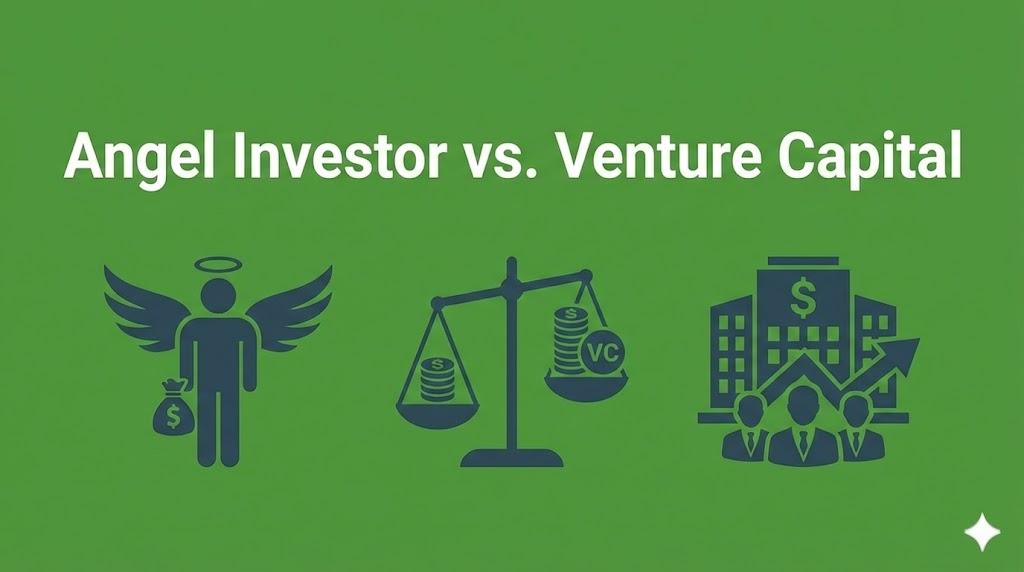
You watch shows like Shark Tank and think that is how it works you stand in a room, pitch, and someone hands you a check. But in the real world, “investors” aren’t a single group. They are split into two very distinct camps: Angel Investors and Venture Capitalists (VCs).
Choosing the wrong one isn’t just about money. It is about who you are inviting into your “business marriage.” One might nurture you with patience, while the other might demand you triple your revenue in six months or face replacement.
If you are feeling overwhelmed by the jargon, you are not alone. In 2026, the funding landscape has shifted, and understanding the Angel investor vs. Venture Capital difference is the single most important thing you can do to protect your company’s future. This guide is going to strip away the confusion, explain exactly who these people are, and help you decide which path if either is right for you.
Before you trade a permanent slice of your company for temporary cash, consider non-dilutive options like Account Receivable Loans to fund growth without shrinking your ownership.
Before we dive into the complex terms sheets and valuation caps, we need to understand the fundamental identity of the people writing the checks. The core Angel investor vs. Venture Capital difference starts with whose money they are actually spending.
An angel investor is a high-net-worth individual who invests their own personal money into startups. Think of them as successful entrepreneurs, retired executives, or wealthy doctors who want to support the next generation of builders. Because they are writing checks from their own bank accounts, they answer to no one but themselves. This makes them inherently more emotional and instinct-driven investors. They invest in you the founder often before the data proves you are going to win.
A Venture Capitalist is completely different. They are professional money managers who invest other people’s money. A VC firm raises massive pools of capital (funds) from institutional giants like pension funds, university endowments, and insurance companies. Their job is not just to help you; it is to generate a massive return for their investors (Limited Partners). They have a fiduciary duty to be ruthless about growth, metrics, and exit timelines.
Speak to a Lending Valley Advisor, Let’s map out a funding strategy that keeps you in the driver’s seat.
If you are trying to spot the Angel investor vs. Venture Capital difference during a meeting, you need to look at five specific factors. These differences will dictate how they treat you, how fast they move, and what they expect in return.
This is the biggest psychological difference. If an Angel investor’s bet goes to zero, they lose their own vacation money or retirement savings. This often makes them more patient and more personally invested in your mentorship. They want you to succeed because they like you.
VCs, however, operate on a “Power Law.” They know that out of 10 investments, 5 will fail, 3 will do okay, and 1 needs to return the entire fund. Because they are playing with institutional money, they need your company to be that “1.” They are looking for “unicorns” (billion-dollar valuations), not just stable small businesses. If you aren’t growing at 100% year-over-year, a VC might lose interest, whereas an Angel might be happy with steady, profitable growth.
Unlike the tech unicorn path, most retail brands thrive better by Scaling Shopify Stores Without Equity, using cash flow to fund growth rather than diluted capital.
In early 2026, inflation has pushed investment floors higher, but the gap remains significant. Angel investors typically write checks ranging from $25,000 to $100,000. You might need to pool several angels together (a “syndicate”) to raise a full round.
VCs, on the other hand, rarely get out of bed for less than $2 million. They have massive funds to deploy, and writing small checks is simply inefficient for them. If you only need $150,000 to launch your app, a VC is the wrong door to knock on. They literally cannot write a check that small because it doesn’t move the needle for their fund.
This is where most founders get rejected. Angels love the “Seed” or “Pre-Seed” stage. You might just have a prototype, a pitch deck, and a dream. They are betting on your grit and vision.
VCs typically come in at “Series A” and beyond. They need proof. By the time you pitch a VC, they want to see “Product-Market Fit.” They want to see customer acquisition costs (CAC), lifetime value (LTV), and monthly recurring revenue (MRR) charts moving up and to the right. The Angel investor vs. Venture Capital difference here is simple: Angels pay for the idea; VCs pay for the scaling of that idea.
When an Angel invests, they often take a “hands-off” approach or act as a casual mentor. They might check in once a month for coffee or offer advice when asked. They rarely demand a seat on your Board of Directors.
VCs are different. They almost always demand a Board seat and protective provisions. This gives them legal voting power in your company. They will have a say in hiring senior executives, setting strategy, and approving budgets. In extreme cases, if the company is underperforming, a VC-controlled board has the power to fire the founder from their own company.
If an Angel likes your pitch, they can wire funds in a week. It’s their money; they can decide instantly. A VC deal is a marriage that takes months. Expect a grueling 3-to-6-month process of financial audits, legal reviews, market analysis, and reference checks. If you need money next week to make payroll, a VC process will not save you.
Expert Insight: “In 2026, we are seeing a ‘flight to quality.’ VCs are no longer throwing money at growth-at-all-costs models. They want profitability paths. Angels, however, are filling the gap for risky, early-stage ideas that VCs are currently too risk-averse to touch.” — Marcus T., Senior Partner at Horizon Ventures
Let’s look at three different businesses to see how the Angel investor vs. Venture Capital difference plays out in real life scenarios.
The Business: A SaaS platform helping local coffee shops manage inventory. The Situation: The founder needed $150,000 to build the beta version of her software. She had no revenue yet, just a prototype. She tried to get a Business Loan in Brooklyn, but banks rejected her for having no cash flow. The Move: She pitched to a local Angel group in NYC. The Result: Two former restaurant owners invested $75,000 each. They understood the pain point personally. They didn’t ask for control, just 10% equity. This allowed her to build the product without the pressure of hitting “hyper-growth” metrics immediately.
The Business: A logistics AI company based in Austin. The Situation: The company was already making $2 million a year but needed $10 million to hire a massive sales team and expand nationally to beat competitors. The Move: They targeted Tier-1 VCs who specialize in Business funding in Texas. The Result: A VC firm led a $12 million Series A round. They took 20% equity and a board seat. The pressure was intense, but the VC introduced them to Fortune 500 clients that tripled their revenue in 12 months. The VC capital acted as rocket fuel.
The Business: A custom furniture maker in Columbus. The Situation: They landed a massive contract with a hotel chain but needed $200,000 for raw materials to fulfill the order. The Move: They spoke to an Angel who wanted 30% of the company for the cash. The founder refused to give up that much ownership for a one-time order. The Result: They looked for Small Business funding in Ohio through alternative lenders. They secured a revenue-based loan, fulfilled the order, paid the loan back, and kept 100% of their equity.
Pros:
Pros:
Common Mistake to Avoid: Do not approach a VC with a “lifestyle business.” If your goal is to build a solid, profitable $5M/year business that you run for 30 years, VCs will hate it. They only want businesses that can sell for $500M or go public (IPO). If you want steady, profitable growth, you should look for a Business loan in Florida or local lending options instead of giving away equity.
Remember that this relationship is a two-way street; just as they audit your financials, you should audit their reputation using our checklist of 7 Things You Should Know Before Choosing a Funding Partner.
Here is the secret most investors won’t tell you: Equity is the most expensive money you will ever buy.
When you take money from an Angel or VC, you are giving away a piece of your future forever. If your company becomes worth $100 million, that $100,000 Angel investment just cost you $10 million. You have to ask yourself: Do I really need a partner, or do I just need cash?
\Lending Valley offers a different path. We believe you should keep your company. If you have revenue and just need capital to grow, buy inventory, or expand, debt financing is often smarter than equity financing.
The Lending Valley Difference:
Don’t let a missing tax return cost you a million-dollar deal; whether it’s an Angel or a VC, they both expect professional business funding documentation to verify that your business is as healthy as you say it is
A: Yes. In fact, this is the standard path for high-growth startups. You use Angel money to start (Seed Round), and once you have grown enough to justify it, VCs come in for the big rounds (Series A, B, C).
A: Legally, to be an Angel investor, a person usually needs a net worth of $1 million+ (excluding their home) or an income of $200,000+/year. This rule exists to protect average people from losing money on risky startups.
A: No. This is the main benefit of equity over debt. Equity investment is risk capital. If the business goes bankrupt, they lose their money. You do not owe them a refund.
A: If you have sales, search for a “Merchant Cash Advance near me” or contact a marketplace like Lending Valley. These products advance you cash based on future sales, not equity, allowing you to bridge the gap without selling shares.
A: Use platforms like AngelList, Crunchbase, or local incubators. If you are looking for Business funding in Newyork, attend local tech meetups or pitch nights where these investors hang out.
A: VCs rarely buy “Common Stock” (what you have). They want “Preferred Stock,” which means they get paid back first if the company is sold, ensuring they cover their downside.
A: No, but their incentives are different from yours. They need a “home run” to survive. If your business is doing “okay,” they might push you to take risky bets to make it “great” or die trying. Understanding this Angel investor vs. Venture Capital difference is key to managing the relationship.
The Angel investor vs. Venture Capital difference isn’t just about math; it is about your life. When you take a check, you are entering a relationship that is harder to leave than a marriage.
You have worked too hard to let desperation force you into a bad deal. Remember, you are the one building the value. You are the prize. The right money is out there waiting for you.
Ready to fund your growth without giving up your company?
Check Your Loan Eligibility Instantly, See how much capital you can access today without selling a single share of stock.