Our goal at Lending Valley is to provide all small business owners access to the best loans possible for their business. You can rest assured we will get you the best rates in the market!

The “Boring” Truth That Stands Between You and Your Money
Let’s be honest. You didn’t start your business because you love filing paperwork.
The reason you started it to bake the best sourdough in Brooklyn. Or you started it to engineer safer roofs in Ohio. You started it to code the next viral app in Texas. Or you definitely did not start it to spend your precious Saturday night scanning tax returns and hunting for a bank statement from three years ago.
I get it. It’s frustrating. It feels like a distraction from the “real work.”
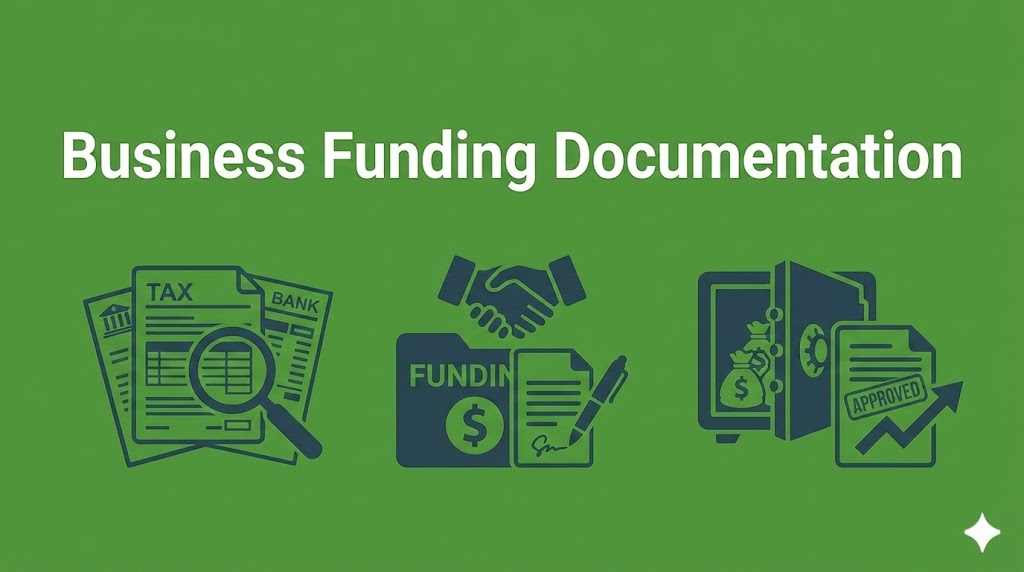
But here is the hard truth that every successful founder eventually faces. In the high-stakes world of finance,Business funding documentation is the must have .
You can have the most charismatic pitch in the world. You can have a product that is flying off the shelves. But if your financial “story” on paper is a mess, the answer from the bank will almost certainly be “No.”
I see this tragedy every day. Brilliant business owners get rejected. Not because their business is bad. But because their folders are messy. In 2026, the stakes are even higher. AI algorithms are now reviewing your files, and they have zero tolerance for missing data.
This guide is your survival kit. It is the “boring” reality that separates the funded pros from the rejected amateurs. Let’s turn that pile of paperwork into a check.
Getting these documents ready is the boring part, but the reward is qualifying for the best lenders in the market like those featured in our review of the top 3 business funding providers.
You might be thinking, “It’s 2026. Can’t I just click a button and get cash?” The answer is a complicated “Yes and No.” Fintech has indeed revolutionized the speed of capital. We now use “digital identity wallets” and AI-driven underwriting that can scan your bank data in seconds. But this speed cuts both ways. If your business funding Documentation is perfect, you can get funded in 24 hours. If your docs are messy, the AI rejects you in 24 seconds.
In fact, “incomplete documentation” remains the number one reason for loan denial in 2026, ranking right alongside actual cash flow issues. The algorithm cannot “read between the lines” or listen to your explanation about why that one month was slow. It needs cold, hard proof. Whether you are seeking a Business Loan in Brooklyn or a line of credit in Texas, having a pristine digital file folder is your best competitive advantage.
Stop guessing if your paperwork is “good enough.” You don’t need to apply blindly and risk a rejection. Check Your Eligibility Instantly, to see exactly which lenders match your current profile without hurting your credit score.
Lenders are essentially risk managers. Before they give you money, they need to understand the narrative of your business. This isn’t just about feelings; it’s about calculating the likelihood of repayment based on your plan.
Many small business owners skip this step when applying for smaller loans, but for SBA or traditional bank financing, it is non-negotiable. A modern business plan doesn’t need to be 100 pages, but it must contain a clear executive summary, a market analysis, and crucially 3-year financial projections. In 2026, lenders are looking for “realistic” projections backed by historical data, not just “hockey-stick” growth charts that look like wishful thinking. They want to see that you understand your market’s ceiling and its floor.However, if you need capital faster than it takes to draft a full projection, you should review our guide on the top 7 quick funding options for small businesses to find lenders who prioritize speed over detailed plans.
This is where most applicants fail. They write “Working Capital” or “Growth” on the application. That is far too vague for a serious underwriter. A proper Use of Funds statement acts like a receipt for items you haven’t bought yet. For example, instead of saying “I need $50k for growth,” you should write: “Purchase $30k in raw lumber inventory to beat Q3 price hikes and $20k for a new CNC router to increase production capacity by 15%.” This level of specificity proves you have a plan to generate a return on investment (ROI). If you are seeking Business funding in Texas to navigate complex supply chain costs, this detail sets you apart from the competition.
This is the engine room of your application. If these numbers don’t balance, the ship sinks. Lenders trust data more than they trust people, so your business funding documentation here must be flawless.
Lenders typically require the last 3 to 12 months of business bank statements. This is non-negotiable. The “Kiss of Death” here is overdrafts. If an underwriter sees Non-Sufficient Funds (NSF) fees, they assume you cannot manage cash flow and will deny the loan immediately. Furthermore, lenders hate “commingling.” If they see personal grocery runs or Netflix subscriptions on your business statements, it signals that you treat the business like a personal piggy bank rather than a separate legal entity.
You generally need the last 2–3 years of both business AND personal tax returns. Here is the “Discrepancy Trap” many owners fall into: If your Profit & Loss (P&L) statement says you made $500,000 last year, but your tax return says you made $50,000 (because you aggressively wrote off expenses to save on taxes), the lender will lend based on the $50,000. You cannot tell the IRS you are poor to save on taxes and then tell the bank you are rich to get a loan. You have to pick a lane.
If you are applying early in the year and haven’t filed your most recent return yet, you will need to rely on interim financials for bridging the tax season gap to prove your current revenue.
Your Profit & Loss statement needs to be current within 90 days (Year-to-Date). For regions with heavy industry, like those seeking Small Business funding in Ohio, the Balance Sheet is critical. It shows your assets versus your liabilities. In 2026, lenders are looking closely at your “Debt Service Coverage Ratio” (DSCR) on these documents to ensure you generate enough operating income to afford the new loan payments on top of your existing debt.
In 2026, Know Your Customer (KYC) laws are stricter than ever to prevent fraud and money laundering. Your legal business funding documentation serves as your digital ID card.
You must have your Articles of Incorporation/Organization and Operating Agreements handy. A major update for 2026 is the strict enforcement of Beneficial Ownership Information (BOI) reporting. You must list anyone who owns 20% or more of the company, and in some cases, verify citizenship status. If your partners aren’t on board with sharing their personal data, you cannot get funded.
You need proof that you are legally allowed to operate (Business Licenses) and that you have a physical place to stay. If you are renting your space, lenders want to see a Commercial Lease Agreement. A specific note for urban borrowers: When applying for a Business Loan in Brooklyn or other high-rent districts, ensure your lease agreement has enough term left to cover the loan period. Lenders get nervous if your lease expires in 6 months but the loan term is for 5 years.
Beyond just having the paperwork, ensuring your lease term matches the loan duration is one of the subtle business funding pre-requisites that can make or break your approval odds
The Scenario: A boutique marketing agency in Chelsea, NYC, had hit a growth ceiling. To take on a massive new tech client, they needed to hire three senior staff members and upgrade their software suite immediately. They required $150,000 in capital, but they knew the lending market was tight.
The Strategy: Instead of panic-applying to every lender on Google, the founder spent a full week “audit-proofing” her application. She worked with her accountant to generate a spotless Year-to-Date Profit & Loss (P&L) statement that matched her bank deposits exactly. She organized three years of business tax returns and, crucially, drafted a specific “Use of Funds” statement detailing exactly how the $150k would generate an ROI of 20% within year one.
The Result: When she applied for Business funding in Newyork, she didn’t just submit an application; she submitted a professional financial package. A Tier 1 bank lender reviewed the file and approved the loan in just 4 days at a highly competitive 9% interest rate. The underwriter specifically noted in the approval file: “The transparency and organization of the financial documents made the risk assessment easy.”
The Scenario: A high-earning freelance consultant in Miami was generating $200,000 a year in revenue. On paper, he looked like the perfect borrower. He wanted a line of credit to smooth out cash flow gaps between big projects.
The Mistake: He treated his business LLC like a personal piggy bank. When he applied for a Business loan in Florida, he submitted statements from his primary checking account. The underwriter saw a chaotic mix of client deposits alongside mortgage payments, grocery runs, Netflix subscriptions, and family vacation expenses. Because of this “commingling,” the lender’s AI software could not accurately calculate his true business Debt Service Coverage Ratio (DSCR).
The Result: He was rejected within 24 hours. The rejection letter was blunt: “Unable to verify net business income.” Despite making $200k, his lack of documentation hygiene cost him the loan. He was advised to open a dedicated business account, run all expenses through it for six months, and try again a delay that stalled his growth plans for half a year.
This lack of separation is the most common mistake new owners make. If you are just incorporating and want to ensure you build a lendable profile from Day 1, read our guide on how to get funding with a new LLC and no revenue.
The Scenario: It was a Tuesday morning when the walk-in freezer at a popular deli in Queens died. The owner was staring at $10,000 worth of premium meats that would spoil within 24 hours if she didn’t replace the compressor immediately. She didn’t have the cash on hand, and she certainly didn’t have time to call her accountant for three years of tax returns.
The Strategy: She needed a solution that prioritized speed over low interest rates. She searched for a “Merchant Cash Advance near me” and found a provider that specialized in revenue-based financing. Instead of asking for a business plan or tax transcripts, the lender simply asked to digitally link her business bank account to verify her daily sales volume.
The Result: Because she had consistent daily deposits, the MCA in Newyork provider approved her in one hour. She uploaded a photo of her driver’s license and a voided check, and the funds were wired by 2:00 PM. While the cost of capital was higher than a bank loan, the speed saved her $10,000 inventory from the dumpster, making the documentation trade-off a savvy financial move.
| Feature | Full Doc (SBA/Bank) | Lite Doc (Alternative/Fintech) |
| Paperwork Load | High (Tax returns, P&L, Business Plan, Debt Schedule) | Low (Bank statements, ID, Voided Check) |
| Funding Speed | Slow (Weeks to Months) | Fast (24–48 Hours) |
| Interest Rates | Lowest (Prime + small margin) | Higher (Risk premium added for speed) |
| Approval Odds | Lower (Strict criteria, 700+ FICO) | Higher (Focus on cash flow & revenue) |
| Best For | Long-term growth, Real Estate, Acquisitions | Emergencies, Inventory, Payroll, Bridge capital |
Let’s be honest: no one starts a company because they love organizing PDF bank statements. However, mastering this ‘boring’ paperwork is the secret key to unlocking fast, stress-free Small Business Financing.
Myth: “I don’t need documents for online loans.”
Fact: You absolutely need documents. Even so-called “no-doc” loans usually require connecting your bank account digitally via APIs like Plaid. This allows the AI to “read” your bank statements instantly. You are still providing business funding documentation, just in a digital format.
Myth: “My personal credit doesn’t matter for a business loan.”
Fact: In 2026, lenders still rely heavily on personal credit (typically 650+) for startups and small businesses. Unless you are a massive corporation, your personal financial habits are viewed as a proxy for how you will manage the business’s money.
Common Mistake: Submitting blurry photos of documents.
It sounds trivial, but taking a cell phone picture of a crumpled bank statement is a surefire way to get rejected by an AI underwriter. Always use proper PDF scans.
Now that you have your paperwork sorted, the next step is to review it yourself to ensure you aren’t accidentally signaling any Business funding Red Flags that could trigger an instant rejection.
At Lending Valley, we know that “disorganization” is the enemy of funding. We don’t just dump a complex application on your desk; we act as your guide through the documentation maze.
A: For traditional bank loans and SBA loans, yes. It shows you understand your risk. For faster, alternative funding like MCAs or online term loans, a simple “Use of Funds” statement often suffices.
A: It is often due to inconsistent cash flow or “negative days.” If lenders see overdrafts in your bank statements, they will reject you regardless of total revenue. Clean up your banking behavior before applying.
A: This is a federal requirement to combat money laundering. You must identify anyone who owns 20% or more of the company. Refusal to provide this info is an automatic disqualification for most lenders in 2026.
A: Yes, but the business funding documentation is different. You will rely more on your personal credit score (680+), personal tax returns, and a solid business plan, rather than business revenue history.
A: Lenders usually accept utility bills (electric, water, internet) in the business name, a commercial lease agreement, or official government correspondence sent to your business location.
A: Yes. In 2026, this is the industry standard. It is often safer than emailing PDFs because it uses encrypted APIs to share read-only data directly with the underwriter, reducing the risk of identity theft.
A: For “emergency” funding, look for revenue-based financing. Have your last 3 months of business bank statements (PDF format), a voided check, and a valid government ID ready. This “lite” business funding documentation package is usually enough for an offer.
Think about why you need this money.
Maybe it’s to buy that new inventory before the holiday rush. Maybe it’s to hire the extra hands you desperately need. Or maybe it’s just to sleep a little better at night knowing you have a safety net.
Now, look at that pile of documents. It looks boring. It looks tedious. But you have to change your perspective.
That isn’t just a tax return. It’s your ticket to expansion. That isn’t just a bank statement. It’s the proof that your dream is working.
The difference between a “struggling” business and a “funded” business is often just a well-organized folder. Don’t let the boring reality of documentation stop you from achieving your vision. You have worked too hard to build this company to let a missing file slow you down now.
Get your files in order. Tell your story clearly. Get the capital you deserve.
Ready to turn those docs into dollars?
Download Our Ultimate 2026 Funding Checklist, Make sure you never miss a single page.