Close
It is 2:00 AM. The rest of the world is asleep, but you are wide awake, staring at a PDF on your laptop screen. The subject line of the email reads “APPROVED,” and the dollar amount inside is exactly what you need to save your payroll this Friday or capitalize on that massive inventory discount. It feels like a lifeline. But then you scroll down. You are looking at 15 pages of dense, terrifying legal jargon. Phrases like “Purchase of Future Receivables,” “Specified Percentage,” and “Performance Guarantee” jump out at you, buried in walls of tiny text.
If you are a business owner in 2026, this moment is the most critical point in your financial year. You are likely looking at MCA contracts (Merchant Cash Advance agreements). This isn’t free money, and it certainly isn’t a standard bank loan. It is fast capital sometimes hitting your account in as little as four hours but the terms inside that PDF can either be the fuel that rockets your business forward or the anchor that drags it under. Whether you are a bodega owner looking for a Business Loan in Brooklyn or a contractor seeking Business funding in Texas, you cannot afford to sign blindly. This guide is your flashlight in the dark, breaking down the fine print, exposing the traps, and giving you the playbook to negotiate a deal that actually works for you.
We always tell business owners that an ounce of prevention is worth a pound of cure. Taking ten minutes to review these specific contract terms today can save you from having to figure out how to get out of merchant cash advance debt tomorrow.
The lending market has evolved significantly over the last few years. In 2026, while states like New York, California, and Utah have passed strict “Truth in Lending” disclosure laws requiring APR transparency, the industry has adapted in complex ways. Predatory lenders have gotten smarter, often hiding aggressive fees in “administrative costs” or structuring MCA contracts to look like sales agreements specifically to bypass usury laws that cap interest rates.
A recent Q1 2026 Fintech Report highlighted a grim statistic: nearly 42% of small business owners did not understand the “Reconciliation Clause” in their funding agreement, leading to immediate default the moment their sales dipped. You cannot afford to be part of that statistic. Understanding the difference between a “loan” and a “purchase of future receivables” is no longer optional; it is a survival skill. When you understand the mechanics, you can leverage the speed of alternative finance without falling victim to its risks.Legal jargon is only half the battle; if you don’t look past the simple multiplier and calculate the effective MCA cost including those origination fees you might sign a deal that drains your profit margin.
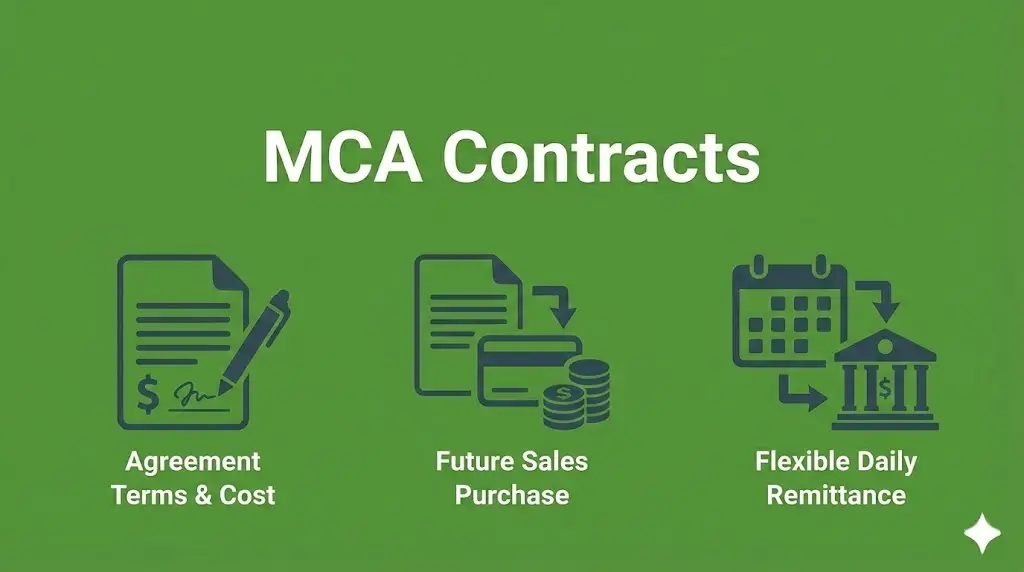
An MCA contract is legally distinct from a loan. You are selling a slice of your future revenue to a funder. Because of this distinction, the contract doesn’t look like a standard promissory note. There are three specific sections you must locate and understand before you even consider picking up a pen.Understanding the fine print isn’t just about legal compliance; it’s about protecting your business from spiraling MCA debt.
This section is the heart of the deal. In a true Merchant Cash Advance, the funder takes a set percentage of your daily sales for example, 15%. This structure is designed to protect you: if you make $0 on a Tuesday, you pay $0 on a Tuesday. However, many predatory MCA contracts will list a “Daily Payment Amount” that appears fixed and never changes, regardless of your sales volume. If you see a fixed daily number without clear language on how it adjusts to your revenue, you are essentially signing a high-interest term loan disguised as an MCA. This removes your safety net and can drain your bank account during slow seasons. It is crucial to understand that mca funding isn’t just ‘fast cash’ it is a specialized financial tool designed for speed, and it requires a specialized contract to match.
If you are reading the fine print and the daily payment schedule makes you nervous, do not force yourself to sign it. Instead, take a step back and explore safer merchant cash advance alternatives that won’t put your daily operational cash flow at risk.
This is arguably the most important paragraph in the entire document. If the lender is taking a fixed daily amount via ACH withdrawal based on your projected sales, what happens if your actual sales tank? A solid contract must state that you have the right to request a “reconciliation” an adjustment of the payment amount to match your actual revenue drop. Be very careful of contracts that say “reconciliation is at the sole discretion of the funder.” This gives them the power to deny your request and keep draining your account even if your revenue drops by 50%. You want mandatory reconciliation language, not discretionary.
This clause is the nuclear weapon of the lending world. A Confession of Judgment essentially says, “I admit I am guilty in advance.” If you sign a contract with this clause and miss a single payment, the lender can bypass the legal system, go straight to a court clerk, and freeze your bank accounts without a trial or a hearing. While New York banned COJs for out-of-state borrowers a few years ago, we still see them hiding in contracts for businesses seeking Small Business funding in Ohio or Florida. If you see this term, you must demand it be removed immediately or walk away.
Compare Vetted Offers, Don’t settle for the first shark that bites. Apply once and let reputable lenders compete for your business.
To truly understand the impact of ink on paper, we need to look at real-world scenarios from early 2026. These stories highlight how the specific terms in MCA contracts can dictate the survival or failure of a business.
Tony owns Tony’s Imports, a staple specialty grocery store in Brooklyn, NY. He needed $40,000 urgently to secure holiday inventory before his suppliers shut down for the season. He couldn’t wait for a traditional bank, so he sought a Business Loan in Brooklyn alternative and found an MCA provider. Before signing, Tony’s financial advisor pointed out the Reconciliation Clause in the contract. This turned out to be a lifesaver. January was brutally slow for the store, and Tony’s revenue dropped by nearly 40%. Because his contract was solid, he emailed the lender with his sales reports, and they were contractually obligated to lower his daily payment from $350 to $210. He survived the slump without overdrafting and paid off the advance comfortably by July.
The owner of Lone Star Riggs in Odessa, Texas, faced a nightmare scenario when a critical piece of equipment failed, threatening a massive contract. He needed Business funding in Texas instantly and signed an agreement for a “Fixed Daily Payment” MCA without reading the fine print. Critically, there was no mandatory reconciliation clause. When oil prices dipped and his revenue slid, the lender continued to pull $800 daily from his operating account. When he called to ask for relief, the lender simply pointed to page 8 of the contract: “Payments are fixed and final.” His operating account hit zero, he missed payroll, and he was forced to take a second predatory loan just to pay the first, entering a cycle known as “stacking.”
A manufacturing company in Cincinnati was looking for Small Business funding in Ohio to upgrade their machinery. The owner accepted a $50,000 advance, focusing entirely on the “Factor Rate” of 1.29 while ignoring the rest of the document. He didn’t realize that the contract included a 5% “Origination Fee” and a weekly “Admin Fee” of $199. He thought he would owe back $64,500. However, after the hidden fees were deducted and added over the term, the total payback was nearly $72,000. The effective APR skyrocketed to over 90%. The business survived, but the owner essentially worked for free for four months just to cover the hidden costs buried in the contract.
When reviewing the ‘Payment Frequency’ clause, don’t just accept the default; understanding the cash flow impact of Daily vs monthly MCA payments is critical, because a daily draw can strangle your operations in ways a monthly check never would.
“In 2026, the most dangerous phrase in an MCA contract is ‘Standard Practices.’ There is no standard. I tell every client: If the salesperson promises you flexibility on the phone, but it is not written in the MCA contracts, it does not exist. The contract is the only reality. Never rely on a handshake or a verbal promise when your business’s cash flow is on the line.”
— Michael Vance, Commercial Finance Attorney, Miami, FL.
Don’t let the legal font intimidate you. Take a red pen to the contract and check these off one by one.
If you aren’t quite at the contract stage yet and just want to know how the funding actually works like speed and credit requirements you should first check out the essential Questions Business Owners Ask Before Taking an MCA.
Pros of MCA Contracts:
The primary advantage is speed. You can often go from application to funding in 24 hours, which is unheard of in traditional banking. Additionally, because the underwriting focuses on cash flow rather than credit scores, approval rates are high even for businesses with a 500 FICO. The structure is also unsecured, meaning you don’t have to pledge physical collateral like your home or vehicles. Finally, if structured correctly with a percentage of sales, the payments fluctuate with your revenue, protecting your cash flow during slow periods.
Cons of MCA Contracts:
The cost is the biggest drawback; factor rates can translate to effective APRs ranging from 30% to over 150%. The terms can be confusing, with “purchase” language making it difficult to compare apples to apples with other loan products. Daily payments can put a significant strain on your operational cash flow, requiring you to maintain a high daily balance. Furthermore, the industry is less regulated than traditional banking, meaning fewer federal protections for borrowers.
These legal clauses aren’t just dry text on a page; they determine the livelihood of real people. If you want to see how these decisions play out beyond the contract, read our collection of Small Business Financing: Real Stories to learn from the triumphs and the regrets of owners who stood exactly where you are now.
The problem often isn’t the MCA product itself, which can be a valid tool for growth; the problem is the opacity of MCA contracts. Direct lenders often send you contracts designed to protect them, not you, hiding fees and aggressive terms in the fine print.
Lending Valley flips the script. They operate as your advocate. We don’t just find you funding; we help explain the terms before you sign. We ensure the Reconciliation Clause is present and fair, protecting your business from revenue dips. Instead of being forced into one bad contract, we let lenders compete for your business, allowing you to choose the terms that fit your needs. We fight to strip out “junk fees” like excessive admin costs and ensure you understand the specific state disclosure laws whether you need an MCA in Newyork or a Business loan in Florida that protect you.
If you are facing an urgent financial hurdle and need to bypass the lengthy legal review typical of traditional agreements, you may want to explore how to secure a Merchant Cash Advance NYC Same Day Funding to get the capital you need in hours rather than weeks.
| Feature | Direct Lender (The “Shark”) | Traditional Bank | Lending Valley (The Partner) |
| Contract Clarity | Low (Hidden clauses) | High (Standardized) | High (We explain it) |
| Speed | 24 Hours | 30-60 Days | 24 Hours |
| Reconciliation | Often missing | N/A (Fixed Loan) | Mandatory Priority |
| Choice | Take it or leave it | Take it or leave it | Compare 5+ Offers |
A: No. It is legally defined as a commercial agreement for the purchase of future receivables. This distinction is crucial because it allows funders to charge rates that would otherwise exceed state usury caps applicable to loans.
A: It is very difficult. Once the funds are wired, the contract is live and binding. Your best bet is to settle or refinance (Consolidate) if the payments become unmanageable.
A: Yes. Florida has its own specific disclosure laws regarding commercial financing. However, many MCA contracts contain a “Choice of Law” provision that makes New York law govern the contract, regardless of where you are located. Always check the “Jurisdiction” clause!
A: The lender can file a lawsuit, freeze your business assets, and if you signed a personal guarantee, potentially come after your personal accounts. This is why understanding the “Default” section is non-negotiable.
A: Yes. Because MCA contracts focus on sales performance and cash flow rather than credit history, approvals are high for businesses with strong revenue, even if the owner has a low credit score.
A: Usually, no. If you have a “Split Withholding” deal where the lender takes a cut of your swipes, switching processors without telling the lender is a breach of contract and causes immediate default.
A: Local brokers exist and can be helpful for face-to-face meetings, but most funding happens digitally. An online marketplace like Lending Valley often gives you better security and access to more reputable options than a single local storefront broker.
Listen, we get it. When you are staring at a bank account that is running low and an offer in your inbox that promises cash by tomorrow morning, the temptation to just click “Sign” and figure it out later is overwhelming. You are busy running a business, not a law firm. But here is the honest truth we want you to walk away with: In 2026, finding capital is actually the easy part. Finding a fair contract? That is the real diamond in the rough.
MCA contracts are powerful tools like a chainsaw. In the right hands, they can clear a path for massive growth, letting you buy that inventory or bridge a seasonal gap. But in the wrong hands, without safety gear, they can cause serious damage. Remember the difference between Tony in Brooklyn and the business in Texas? It wasn’t luck, and it wasn’t even the interest rate. It was a single paragraph on page five the Reconciliation Clause. That one sentence was the difference between a lifeline and a sinkhole.
You have poured too much sweat, equity, and late nights into building your legacy to let a few lines of fine print take it all away. Treat this contract like a marriage know exactly what you are getting into, warts and all, before you say “I do.”
You don’t have to be a legal expert to win this game; you just need to be careful, and you need the right partner in your corner.
Ready to get funded without the fear?
get a Free Contract Review, Have a pending offer? Send it to us. We’ll help you spot the traps so you can sign with confidence.