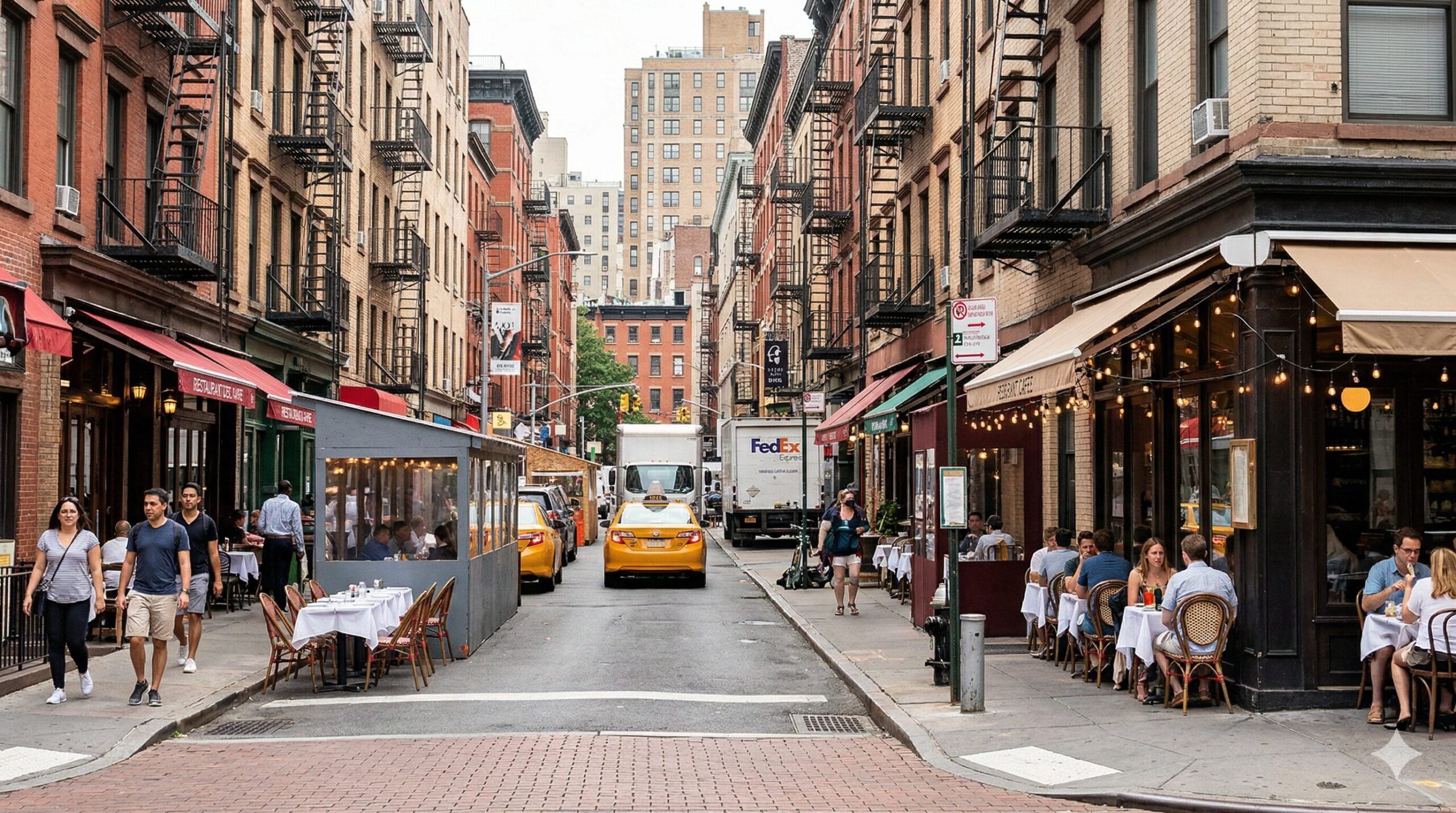
Alt text: “NYC restaurant owner reviewing business funding options on a laptop inside a Manhattan dining room”
Table of Contents
Why NYC Restaurants Need Business Funding
New York City is home to more than 25,000 restaurants, according to the NYC Department of Health. The industry employs approximately 423,000 workers — roughly 10% of all private-sector employees in the city — and contributes over $17 billion annually to the city’s GDP, according to the New York State Comptroller’s Office. The scale is enormous. So is the pressure.
A U.S. Small Business Administration study consistently shows restaurants among the most capital-intensive small businesses to operate. In New York, that pressure is amplified by some of the highest commercial rents and labor costs in the nation. According to industry surveys, 78% of NYC restaurant owners report that rising costs — food, labor, rent — are their single biggest challenge.
Common reasons NYC restaurant owners seek business funding include:
- Covering seasonal revenue gaps (summer slowdowns, post-holiday dips)
- Emergency equipment repairs (refrigeration units, HVAC, commercial ovens)
- Expanding into catering, delivery, or a second location
- Hiring and training staff before peak season
- Renovations required by the NYC Department of Health after inspections
- Purchasing bulk inventory at favorable supplier pricing
Whatever the trigger, the need is usually urgent. That’s why understanding every business funding option available to you is essential — before a cash crunch becomes a crisis.
Top Funding Options for NYC Restaurants in 2026
Not every funding product is the right fit for every restaurant. Here’s a practical overview of the main options available to NYC food and beverage businesses this year.
Working Capital Loans
A short-term working capital loan is one of the most flexible tools a restaurant owner can use. Funds arrive in as little as 24 hours, and you repay over a fixed term — typically 3 to 18 months. Amounts typically range from $10,000 to $500,000. These work well for covering payroll, rent, or inventory while you wait for a busy season to kick in.
Merchant Cash Advance (MCA)
An MCA is not technically a loan — it’s an advance against your future credit card sales. Repayment happens automatically as a fixed percentage of your daily card transactions. For restaurants that process high card volume, this is often the fastest and most frictionless funding path available.
SBA Loans
SBA 7(a) and 504 loans offer the lowest interest rates — typically 10%–14% — and the longest repayment terms. However, approval takes weeks or months and requires extensive documentation. These are best suited for restaurant owners planning a significant expansion or purchase, not immediate cash needs.
Equipment Financing
If you need a new commercial oven, walk-in freezer, or POS system, equipment financing lets you spread the cost over time while the equipment itself serves as collateral. Interest rates are typically lower than unsecured loans because the lender has a tangible asset to recover if needed.
Business Line of Credit
A business line of credit gives you a revolving pool of capital to draw from as needed — ideal for restaurants managing unpredictable weekly expenses. You only pay interest on what you draw.
Alt text: “Comparison infographic showing five restaurant business loan types available in New York City, including speed, cost, and credit requirements”
Merchant Cash Advance: The Fastest Route for NYC Restaurants
If you’ve ever been denied by a bank — or simply don’t have time for a 60-day approval process — a merchant cash advance is likely your best path forward. Here’s why MCAs are particularly well-suited to the restaurant industry:
Repayment Flexes With Your Revenue
Unlike a fixed-payment loan, an MCA is repaid as a percentage of your daily card sales (the “retrieval rate,” typically 10%–20%). On a slow Monday after a holiday weekend, you pay less. On a packed Friday night, you pay a bit more. This natural alignment with restaurant revenue cycles is a major advantage for operators dealing with seasonal swings.
No Collateral Required
MCAs are entirely unsecured. You don’t pledge your equipment, inventory, or personal property. Your daily revenue is the collateral. This makes MCAs accessible to newer restaurants that haven’t built up significant assets.
Bad Credit Is Not a Dealbreaker
Alternative lenders evaluate your bank statements and card processing history — not your FICO score. Restaurant owners with scores as low as 500 can qualify, provided they demonstrate steady monthly revenue (typically $8,000–$10,000 minimum) and at least six months of business history.
“We look at your last 3 months of deposits to understand how your business is actually performing — not a three-digit number that may not reflect your reality.”
What It Costs
MCAs use factor rates rather than annual percentage rates. A factor rate of 1.25 on a $50,000 advance means you repay $62,500 total. Depending on how quickly you repay, this can equate to a high effective APR — which is why MCAs are best used for short-term needs where speed and flexibility outweigh cost. Explore how MCA factor rates work before committing.
SBA Loans for NYC Restaurant Owners
If your restaurant is financially stable and you’re planning a significant capital investment — a second location, a major renovation, or purchasing commercial kitchen equipment at scale, an SBA loan is worth the wait.
SBA 7(a) Loan
The most popular SBA product, the 7(a) loan, provides up to $5 million with repayment terms of up to 10 years for working capital (25 years for real estate). Rates typically run Prime + 2.75%–4.75%, which at current prime rates translates to roughly 10%–14% APR. You’ll need a credit score of 650+, two years of tax returns, and a solid business plan.
SBA 504 Loan
The 504 is specifically designed for major fixed-asset purchases — commercial real estate or large equipment. If you’re buying the building that houses your restaurant, this is the right vehicle. Down payments as low as 10% are possible.
NYC Local Programs
In 2026, NYC launched several programs specifically to support small businesses:
- NYC Future Fund: Minimum loan reduced to $25,000, interest rate lowered to 7.5%, with monthly repayments as low as 2% of revenue.
- NYC Elevating Business Loan Program: Up to $100,000 for qualifying small businesses across the five boroughs.
These programs are administered through community development financial institutions (CDFIs) and may have income or location eligibility requirements. Visit NYC Business Financing Assistance for details.
How to Qualify for Restaurant Funding in NYC
Qualification requirements vary significantly by product, but here’s what most lenders — alternative and traditional — will look at:
For Alternative Lenders (MCAs, Working Capital Loans)
- Time in business: Minimum 6 months (some require 1 year)
- Monthly revenue: At least $8,000–$10,000 in business bank deposits
- Credit score: 500+ (though revenue matters more than credit)
- Documents needed: 3–6 months of bank statements, government ID, voided business check, business license
For SBA Loans
- Time in business: Typically 2+ years
- Credit score: 650+ personal, strong business credit
- Revenue: Consistent revenue sufficient to service debt
- Documents needed: 2 years of business and personal tax returns, P&L statements, balance sheet, business plan, collateral documentation
If your credit history has some blemishes, consider starting with an alternative lender to build a track record, then refinancing with an SBA loan once you’ve demonstrated consistent performance. Learn more about bad credit business loan options that may bridge this gap.